

USA Automotive Composites Market Led by Midwest Region with Owens Corning and Hexcel Driving Growth
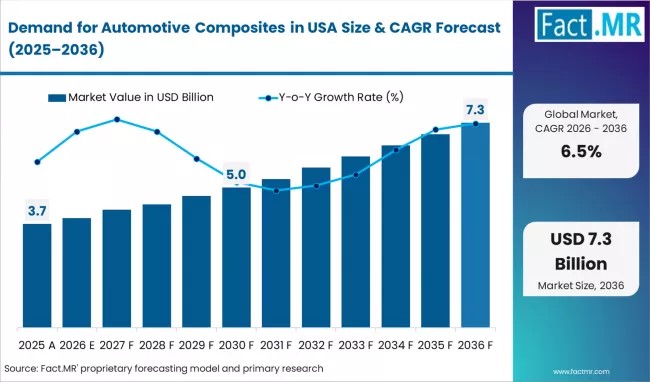
Demand for Automotive Composites in the U.S. rises with EV adoption, lightweighting trends, and strict emission norms driving advanced material innovation.
ROCKVILLE, MD, UNITED STATES, April 7, 2026 /EINPresswire.com/ -- The United States Automotive Composites Market is entering a transformative growth phase, driven by the structural demands of the electric vehicle (EV) transition and tightening federal fuel economy mandates. According to the latest strategic analysis by Fact.MR, the U.S. market—a primary engine of global composite innovation—is projected to expand at a steady CAGR of 6.50% through 2036.As the North American automotive industry targets more aggressive decarbonization goals, composites are evolving from "premium-only" niche materials into high-volume structural essentials. The market is increasingly defined by a shift toward thermoplastic composites and bio-based resin systems as OEMs seek to balance mass reduction with end-of-life recyclability.
For Details Deep insights, Please Request A sample report for Free: https://www.factmr.com/connectus/sample?flag=S&rep_id=12462
Market Dynamics: The Lightweighting Imperative
EV Range Extension: With battery packs adding significant weight to vehicle architectures, U.S. automakers are utilizing carbon and glass fiber composites to offset mass. Reducing vehicle weight by 10% can improve fuel economy by 6–8%, a critical factor for both ICE efficiency and EV range.
Regulatory Tailwinds: The tightening of Corporate Average Fuel Economy (CAFÉ) standards is acting as a mandatory catalyst for the adoption of composite liftgates, hoods, and chassis components.
Technological Crossover: The U.S. market benefits from a unique "aerospace-to-auto" technology transfer, leveraging the high-volume manufacturing expertise of domestic defense and aviation supply chains to lower the cost of automotive prepregs.
Strategic Supply Chain: Tiers of Innovation
The U.S. automotive composites supply chain is a highly integrated network of material science leaders and Tier-1 integrators:
Raw Material Providers (Upstream): Companies like Toray Industries (USA) and Owens Corning supply the high-performance carbon and glass fibers.
Resin and Intermediate Producers (Midstream): BASF, Solvay, and Huntsman provide the specialized epoxy and thermoplastic resin systems.
Tier-1 Component Manufacturers (Downstream): Firms such as Continental Structural Plastics (CSP) and Magna International transform these materials into finished body panels, battery enclosures, and structural reinforcements for OEMs like Ford, GM, and Stellantis.
Key Market Segments
Fiber Type: Glass Fiber Composites remain the volume leader due to their cost-effectiveness and durability. However, Carbon Fiber Composites are the value leaders in the performance and luxury EV segments, projected to grow at a faster rate as manufacturing cycles accelerate.
Resin Type: Thermoplastics (PEEK, PPS) are gaining significant ground over thermosets, favored for their rapid processing times (injection molding) and superior recyclability.
Application: Body Panels and Under-the-Hood components currently dominate, while Battery Enclosures represent the fastest-growing application area due to the thermal management and EMI shielding properties of specialized composites.
Competitive Landscape & Regional Outlook
The U.S. remains the epicenter of automotive composite R&D, with the Midwest (Michigan/Ohio) serving as the primary hub for manufacturing and OEM integration.
Key Players: Hexcel Corporation, Solvay, SGL Carbon, Owens Corning, and Teijin Limited.
Pricing Trends: While material costs remain higher than steel or aluminum, the Total Cost of Ownership (TCO) is decreasing as automated processes like High-Pressure Resin Transfer Molding (HP-RTM) reduce cycle times from minutes to seconds.
Risk Assessment & Future Outlook
Risks: The primary hurdle remains the high initial capital expenditure for composite-specific tooling and the ongoing volatility in carbon fiber precursor (PAN) pricing.
Actionable Insights: Decision-makers should prioritize investments in Hybrid Material Solutions—combining metals with composites—to achieve weight targets without the cost penalty of all-composite structures.
Investment Opportunity: High-ROI potential is concentrated in Recycled Carbon Fiber (rCF) technologies, as U.S. OEMs face increasing pressure to adopt "circular economy" practices in vehicle manufacturing.
For instant access to this report, click “Buy Now” or connect with our analyst for customization: https://www.factmr.com/checkout/12462
To View Related Report:
Automotive Smart Display Market https://www.factmr.com/report/251/automotive-smart-display-market
Low Voltage Motors Market https://www.factmr.com/report/256/low-voltage-motors-market
Railcar Leasing Market https://www.factmr.com/report/264/railcars-leasing-market
Automotive Cabin Air Filter Market https://www.factmr.com/report/266/automotive-cabin-air-filter-market
About Fact.MR
Fact.MR is a global market research and consulting firm, trusted by Fortune 500 companies and emerging businesses for reliable insights and strategic intelligence. With a presence across the U.S., UK, India, and Dubai, we deliver data-driven research and tailored consulting solutions across 30+ industries and 1,000+ markets. Backed by deep expertise and advanced analytics, Fact.MR helps organizations uncover opportunities, reduce risks, and make informed decisions for sustainable growth.
S. N. Jha
Fact.MR
+ +1 628-251-1583
sales@factmr.com
Legal Disclaimer:
EIN Presswire provides this news content "as is" without warranty of any kind. We do not accept any responsibility or liability for the accuracy, content, images, videos, licenses, completeness, legality, or reliability of the information contained in this article. If you have any complaints or copyright issues related to this article, kindly contact the author above.
